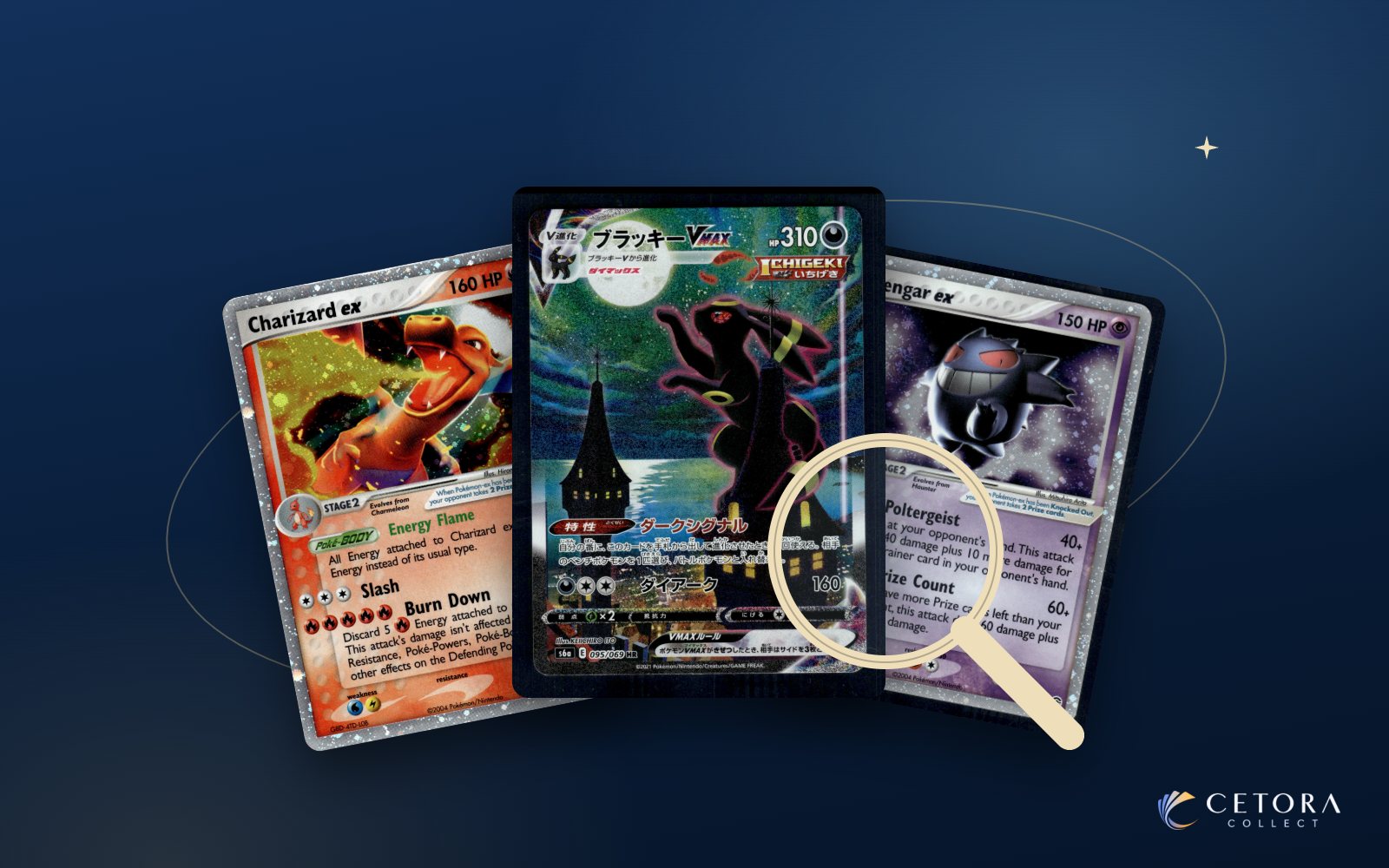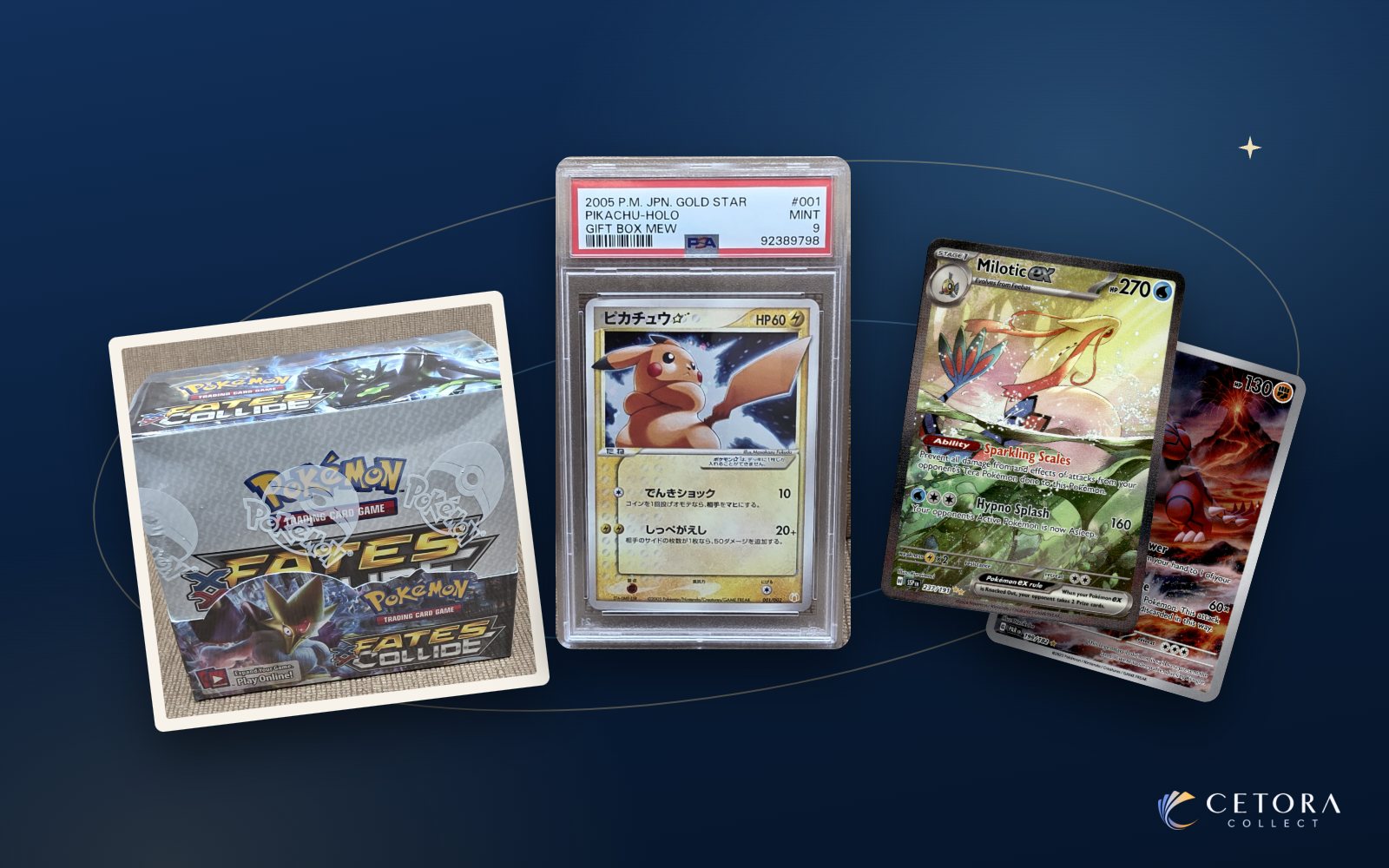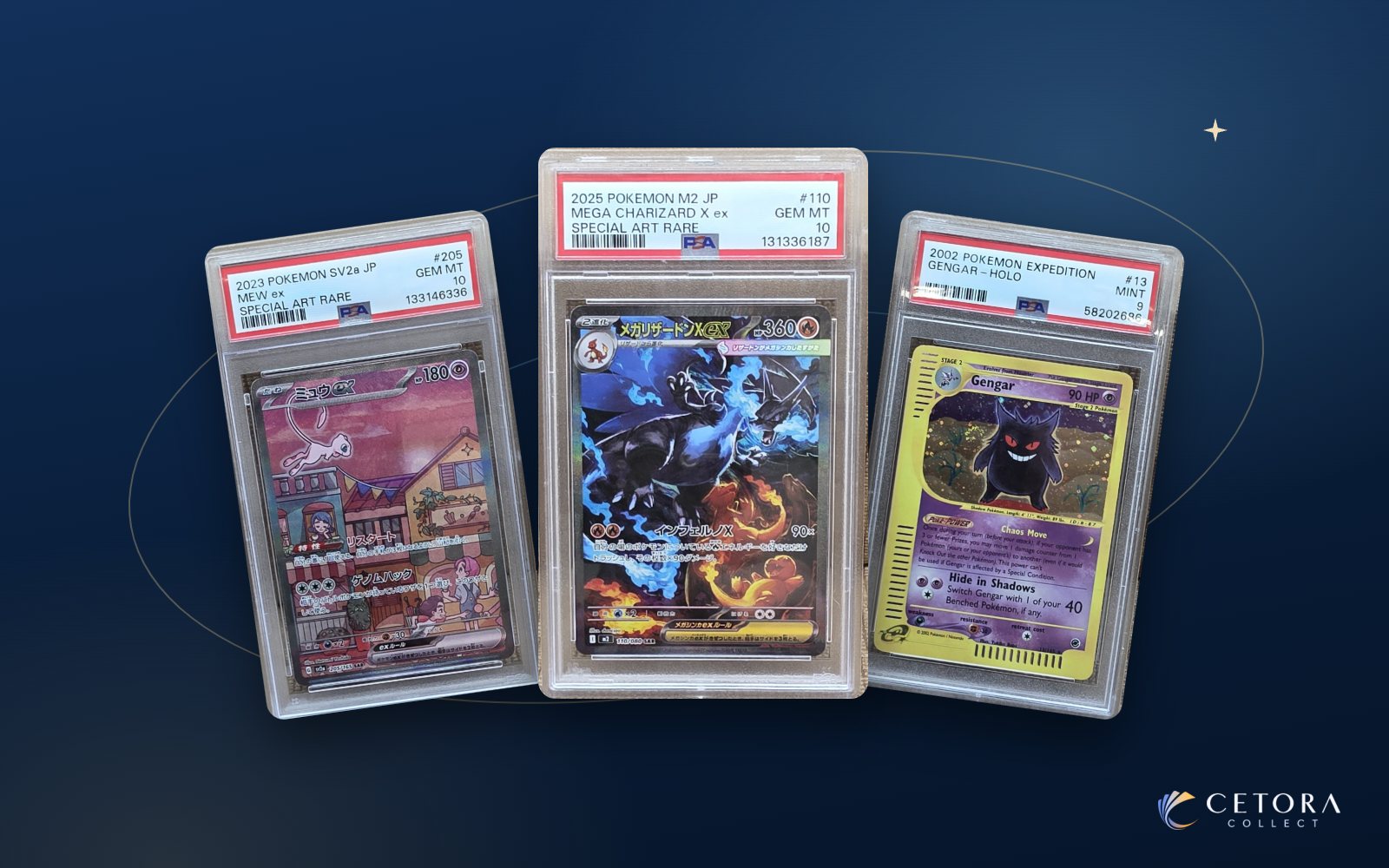
A Pokémon card graded 10 can be worth several times the price of the same copy ungraded. That is enough to make you want to send all your best cards to PSA. But grading is expensive, takes time and never guarantees the grade you are hoping for: used unwisely, it loses you money.
This guide explains how a card is graded, what sets PSA, BGS and CGC apart, what grading really costs from Switzerland, and how to work out whether it pays off for your card.
What is grading?
Having a card graded means entrusting it to an independent company that:
- authenticates it: a counterfeit or altered card is not graded;
- assesses its condition and gives it a grade, usually out of 10;
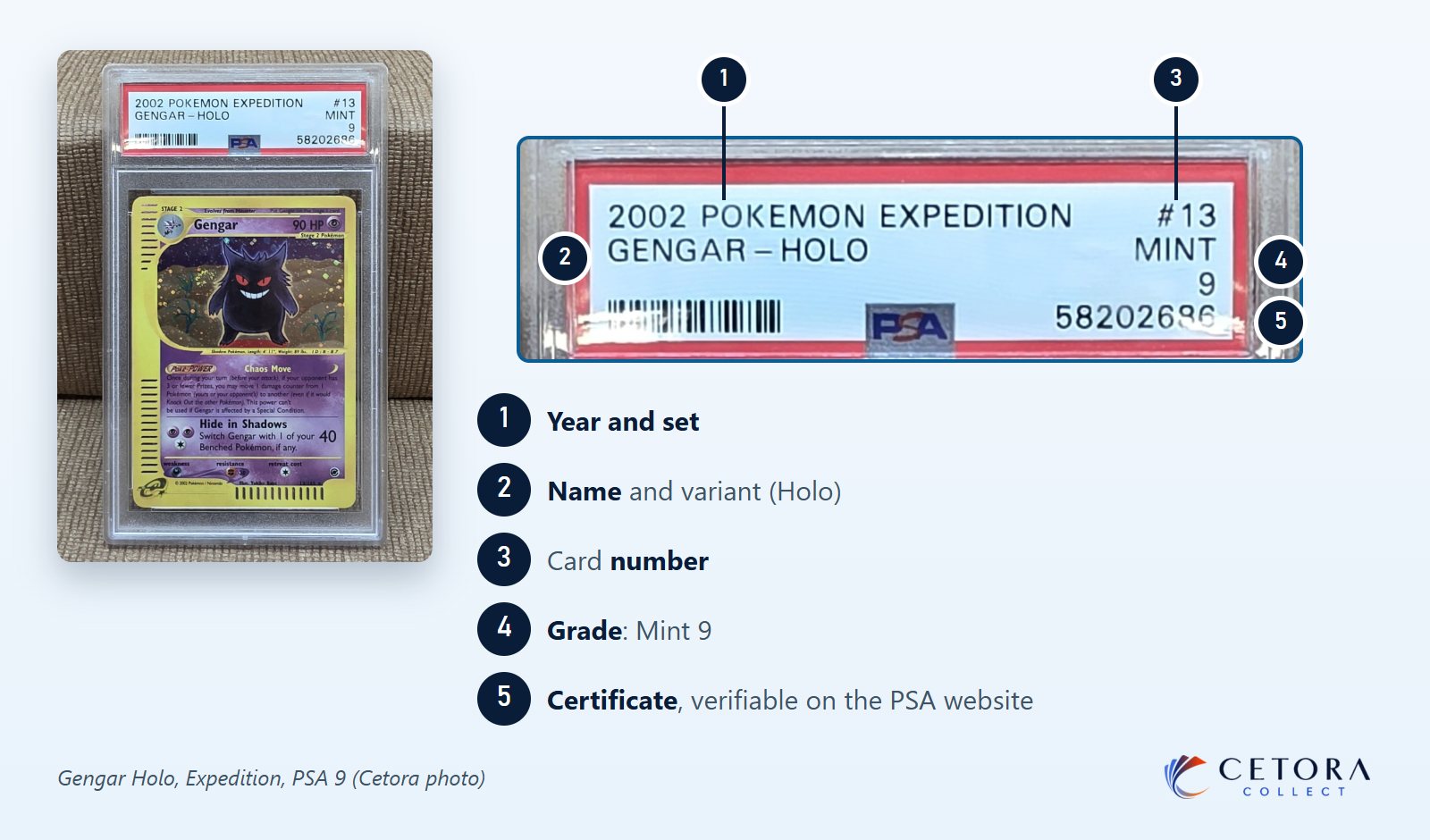
- seals it in a rigid case (the “slab”) with a label showing the card, the grade and a unique certificate number.
For a buyer, a graded card offers two valuable guarantees: it is authentic, and its condition has been judged by a third party. This is what explains the price gap compared with ungraded cards, especially at the top grades.
PSA, BGS or CGC: what are the differences?
Three companies dominate Pokémon card grading. All of them grade out of 10, but their scales, services and current circumstances differ, and the landscape has changed a great deal over 2025 and 2026.
| Company | Scale | Subgrades | Good to know (October 2026) |
|---|---|---|---|
| PSA | 1 to 10, half-points from 2 to 9 (no 9.5) | No | The most widely used for Pokémon cards, often the easiest to resell. European centre opened in Frankfurt in 2026. |
| BGS (Beckett) | 1 to 10 in half-points, up to Pristine 10 | Yes: centering, corners, edges, surface | The “Black Label” rewards four subgrades of 10. Acquired by PSA's parent group (announced at the end of 2025); in early October 2026, only its Express service was accepting submissions. |
| CGC | 1 to 10 in half-points, with Pristine 10 and Gem Mint 10 | No, no longer offered | Has been grading TCG cards in Munich since January 2026. |
At Beckett, the final grade is not an average: the lowest subgrade carries the most weight. At PSA, at least two graders must agree on the grade. Other companies also grade Pokémon cards in Europe, such as ACE in the United Kingdom or PCA in France, but they are less widely used on the international market.
How a card is graded
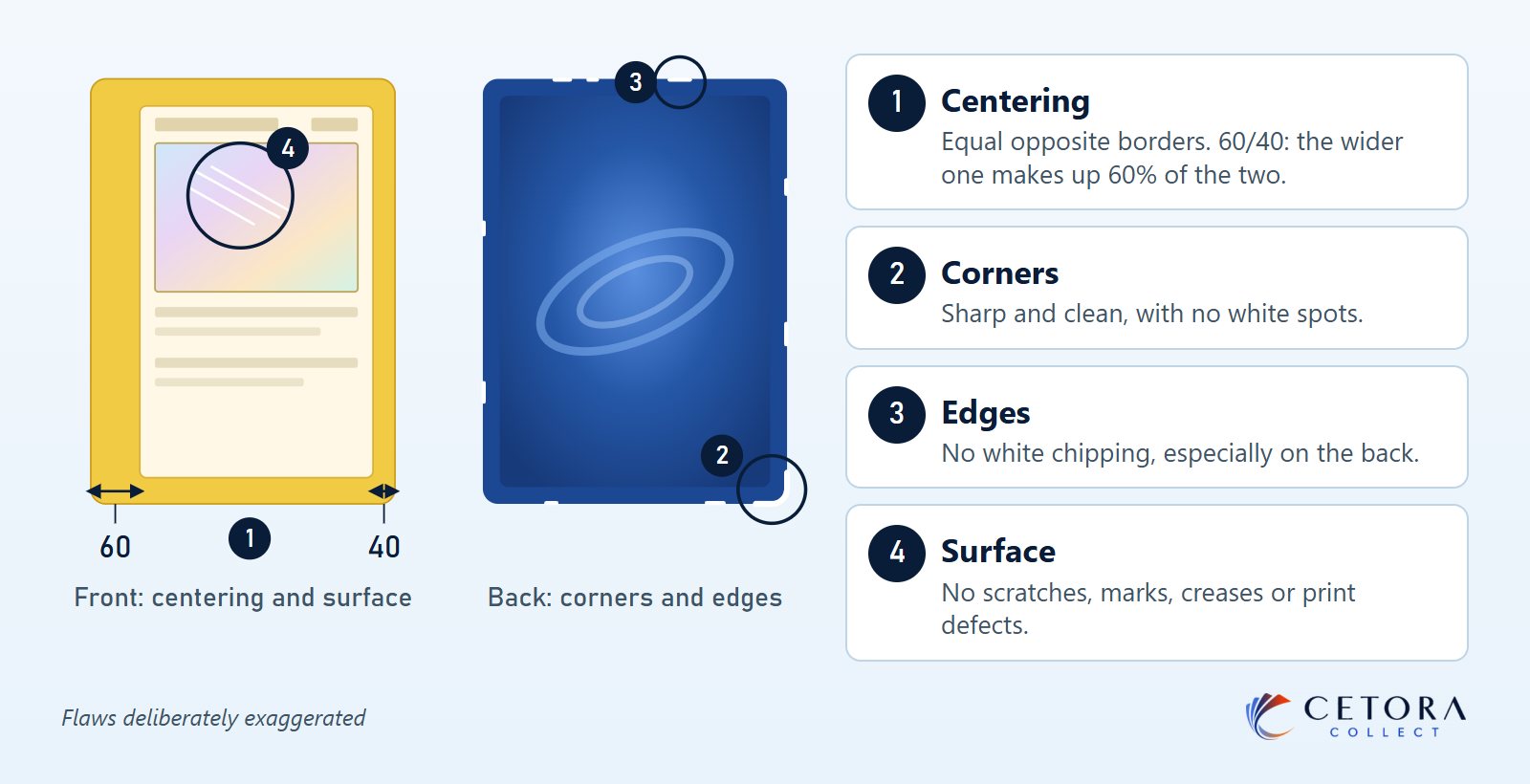
Grading standards differ from one company to another, but they are all based on four criteria.
Centering
Centering measures the balance of the borders around the artwork, left and right, top and bottom, on the front as well as the back. It is expressed as a percentage: a card centred “60/40” has one border that accounts for 60% of the two opposite borders combined. It is a manufacturing defect: it cannot be corrected, and it is often enough to rule out the top grade.
The maximum tolerances published by the companies for the top grades:
| Grade | Front | Back |
|---|---|---|
| PSA 10 (Gem Mint) | 55/45 | 75/25 |
| PSA 9 (Mint) | 60/40 | 90/10 |
| BGS Pristine 10 | 50/50 | 60/40 |
| BGS Gem Mint 9.5 | 50/50 one way, 55/45 the other | 60/40 |
| CGC Gem Mint 10 | 55/45 | 75/25 |
PSA states that it allows a little leeway on front centering when the card's overall appearance is very good.
Corners
Corners must be sharp and crisp. The slightest rounding, crushing or white spot shows up under a magnifying glass and costs points.
Edges
Edges are examined along their entire length. On the back, the dark blue immediately reveals white chips, even tiny ones.
Surface
Scratches, marks, fingerprints, creases, but also printing defects such as lines or dots on the holographic area: surface is often the hardest criterion to judge for yourself, because many defects only appear under low-angle light.
PSA 9 or PSA 10: why the gap is so wide
On a scale of 10, you might think a 9 is worth almost as much as a 10. On the market, that is rarely the case: for sought-after cards, a 10 is the only grade many collectors want, and it is rarer. The price of a 10 is commonly double that of a 9, sometimes much more, even though the difference between the two cards comes down to a barely visible detail.
To measure this gap for your card, compare its estimates grade by grade, for example in the Collectr app, then check them against recent sales. That is what grading is all about: a card is only really worth grading if it has a good chance of getting the top grade.
How much does grading really cost from Switzerland?
The price listed by the grading company is only part of the cost. From Switzerland, you need to factor in:
- the grading fee, which depends on the service level and the card's declared value;
- the outbound shipment, tracked and insured, with suitable packaging;
- the return shipment, charged by the grading company;
- the VAT and customs clearance fees when the card comes back into Switzerland;
- the intermediary's fees, if you use a group submission service;
- the turnaround time: several weeks to several months depending on the service level, during which the card is tied up.
Prices in October 2026
- PSA: the “Value” levels, the cheapest ones, have been suspended since June 2026 while a backlog of several million cards is cleared. The cheapest level still open, “Standard”, costs 59.99 dollars per card in the United States and 49.99 euros as a launch price at the European centre in Frankfurt (59.99 euros afterwards), with a stated turnaround of 80 to 100 working days depending on the centre.
- From Switzerland: PSA has opened direct submissions to Frankfurt to collectors in the European Union, without mentioning Switzerland. The usual route is through authorised dealers in Switzerland, listed on the PSA website, who group submissions together. Their advertised prices in October 2026 are around 100 francs per card for a mid-range service level, and the services included vary: group submission, customs clearance, return.
- CGC: the company now grades TCG cards in Munich, from around 20 euros per card for a group submission of at least 25 cards (German VAT included for private individuals). Check the conditions for sending from Switzerland.
- Beckett: in early October 2026, only the Express service, at 79.95 dollars per card, was accepting submissions.
On top of these prices come shipping, insurance, the return and, when crossing the border, VAT and customs clearance fees: ask the intermediary what is included. For goods sent abroad to be worked on and then sent back, the Federal Office for Customs and Border Security (FOCBS) in principle only taxes the cost of the work and the transport on their return, provided the purpose of the shipment was stated in the export declaration; otherwise, VAT may be charged on the value of the card. As grading is not explicitly mentioned, ask the FOCBS or the intermediary to confirm the procedure before sending valuable cards. Prices and turnaround times change quickly: check them when you send your cards.
Which cards are worth grading?
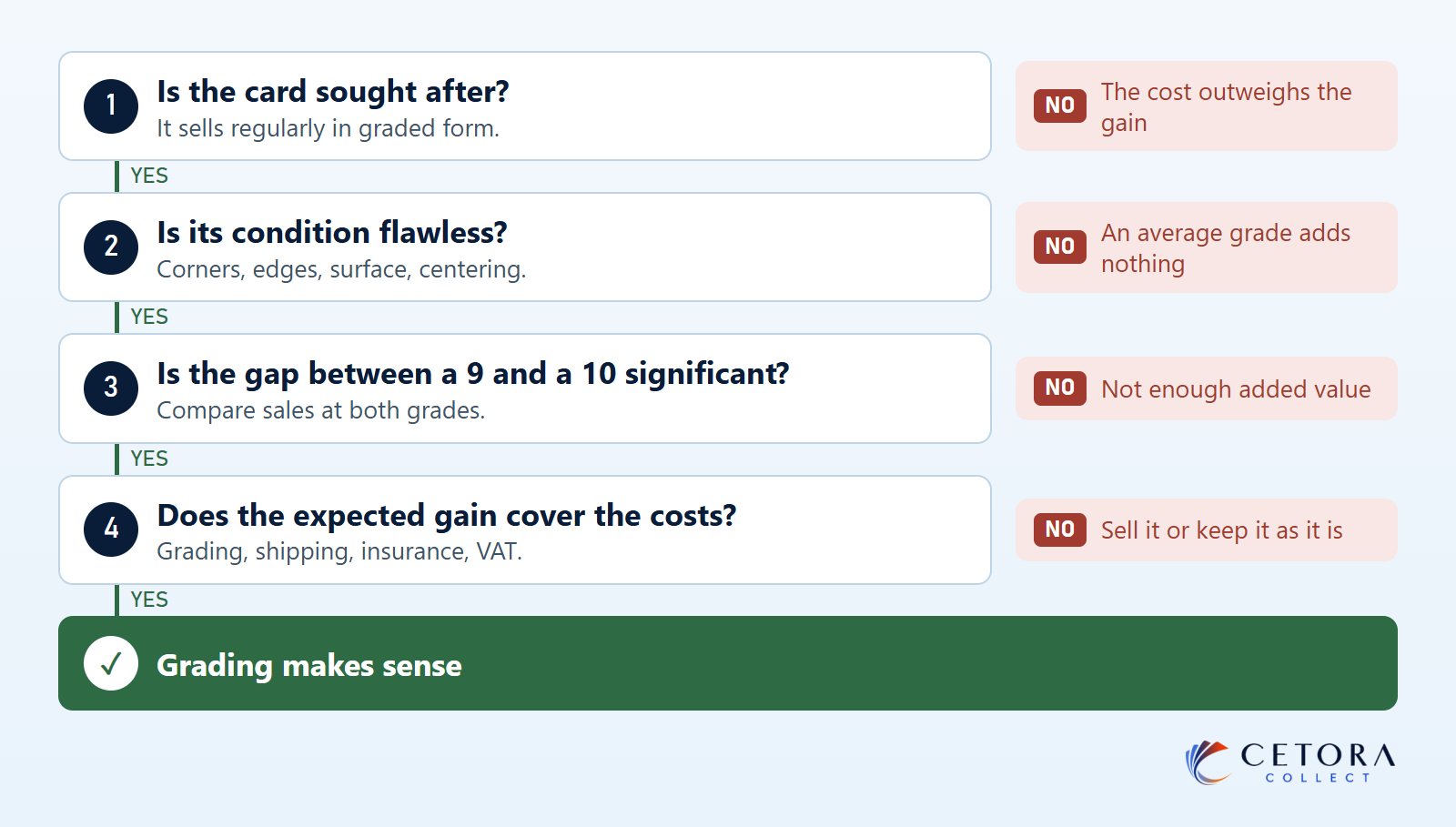
In practice, grading makes sense for:
- sought-after cards, whose graded version sells regularly;
- cards in flawless condition, straight out of the booster pack and protected ever since;
- vintage or rare cards, for which authentication is very reassuring to buyers;
- cards you want to keep for a long time: the slab gives them lasting protection.
Calculating profitability, with an example
Let's take a fictional card with the following market prices:
| Version | Market price |
|---|---|
| Ungraded card, in great condition | CHF 400.– |
| Graded PSA 9 | CHF 430.– |
| Graded PSA 10 | CHF 850.– |
At first glance, grading seems the obvious choice: CHF 850.– versus CHF 400.–. But it all depends on the probability of getting a 10. Let's assume a total grading cost of CHF 100.–, a typical figure for a mid-range service level through a Swiss dealer, shipping and return included, and that if it fails, the card gets a 9.
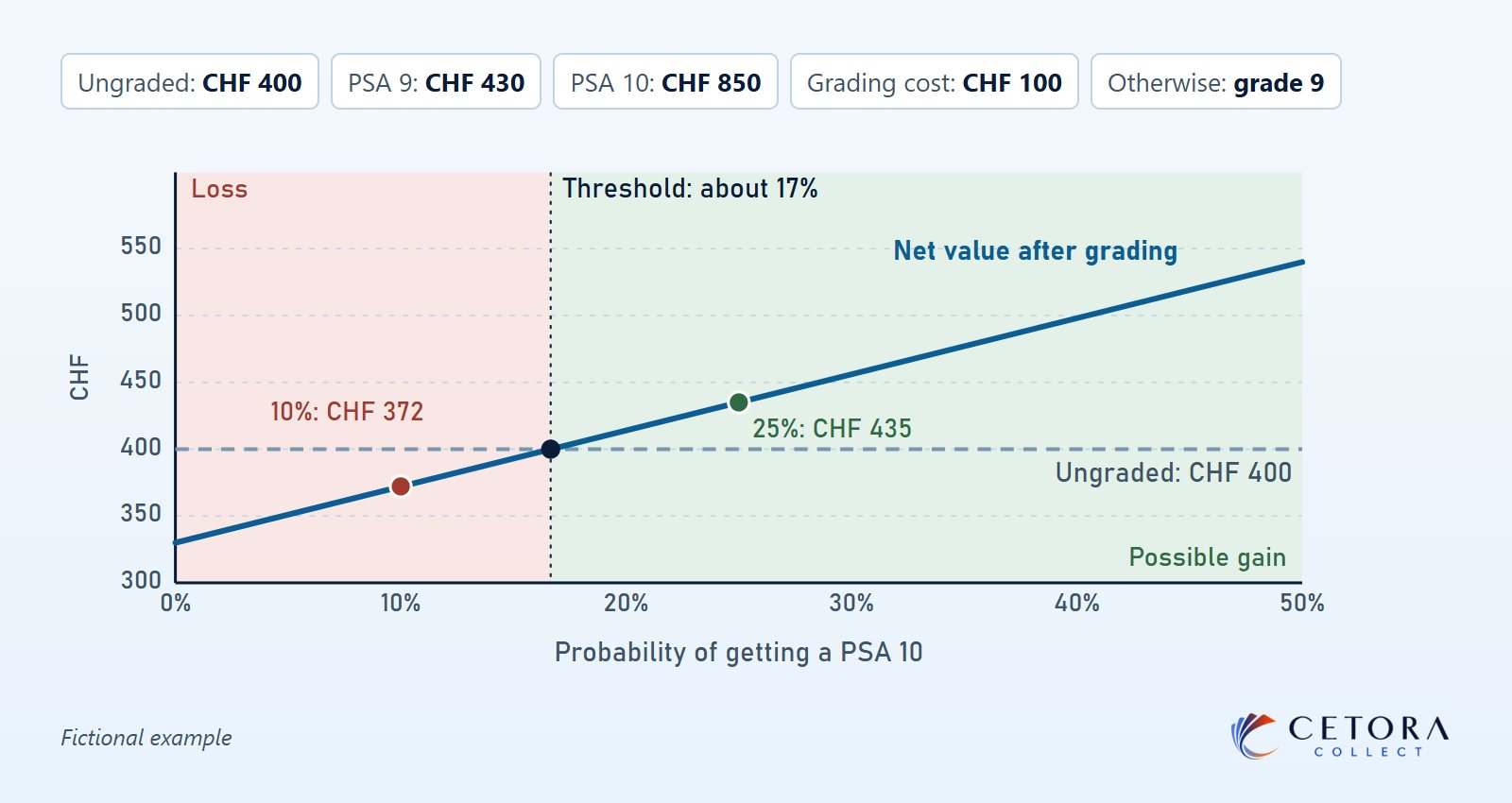
- With a one-in-four chance of getting a 10, the expected value is 0.25 × 850 + 0.75 × 430 = CHF 535.–, or CHF 435.– once the CHF 100.– has been deducted: barely more than the CHF 400.– you started with, for months of waiting and a real risk.
- With a one-in-ten chance, the expected value drops to CHF 472.–, or CHF 372.– after costs: grading loses you money.
- Here, the break-even point is around a 17% chance of getting a 10. Below that, you are better off selling the card as it is.
And this calculation is optimistic: a card can also get an 8, or even lower, and the price of a PSA 9 card is sometimes lower than that of a nice ungraded card.
What are the chances of getting a 10?
Statistics compiled by GemRate from population reports give a rough idea: about half of the trading card game cards graded by PSA in 2025 received a 10. But the share varies widely from one set to another: 33% for Prismatic Evolutions, 30% for Journey Together, 56% for Mega Evolution (October 2026 data). And these figures are flattering: collectors only send in their best cards, after sorting through them. For a card picked at random from a binder, the probability is much lower.
Why you shouldn't get everything graded
- The fixed cost exceeds the value of most cards.
- The grade is never guaranteed: a card that looks perfect to the naked eye can reveal flaws under a magnifying glass.
- A middling grade can bring the price down: a buyer sometimes prefers an ungraded card, where they can still hope for better.
- The turnaround time ties up the card for weeks or months.
- The shipping risk is never zero, even with insurance.
The smart move: have only a few cards graded, but the right ones.
Buying an already graded card
If you are looking for a card at the top grade, buying one that is already graded is often cheaper than trying your luck with several copies. You know the grade before you pay, and you can check it using the certificate number.
Do you own graded cards, or cards you are unsure whether to get graded? We can also make you a buyback offer: offer us your cards.
Frequently asked questions
How long does grading take?
From a few weeks to several months, depending on the company, the service level and the volume of submissions. In October 2026, PSA quotes 80 to 100 working days for its Standard level and 20 to 30 working days for Express. Add the time taken by the group submission and the return to Switzerland.
Can a graded card be regraded?
Yes, by taking it out of its slab to submit it again, or by entrusting it to another company. It is a costly process, best reserved for cards whose grade could make a significant difference to their value.
Is PSA always the best choice?
For Pokémon cards, PSA is the most widely used and often the easiest to resell. But BGS and CGC have their followers, and prices vary from card to card: compare recent sales of the card you are interested in for each company and each grade.
Can you get a French or Japanese card graded?
Yes, the major companies grade cards in many languages. Demand for the graded version does, however, depend on the language: check that there are sales of the graded card in your language before sending it.