Selling Pokémon cards in Switzerland has never been easier… on the face of it. With international platforms, Swiss websites, collector groups and professionals, there is no shortage of options. But each one has its own fees, timescales and risks, and the best choice depends on what you are selling.
This guide gives an honest comparison of all the options, including the one we offer: buyback. That way, you can make an informed choice, card by card or for your whole collection.
Before selling: know what you have
Whichever option you choose, start by sorting your collection and spotting the cards that account for most of its value. Our guide How do you find out what your Pokémon cards are worth? explains how to identify a card, assess its condition and find out its real price.
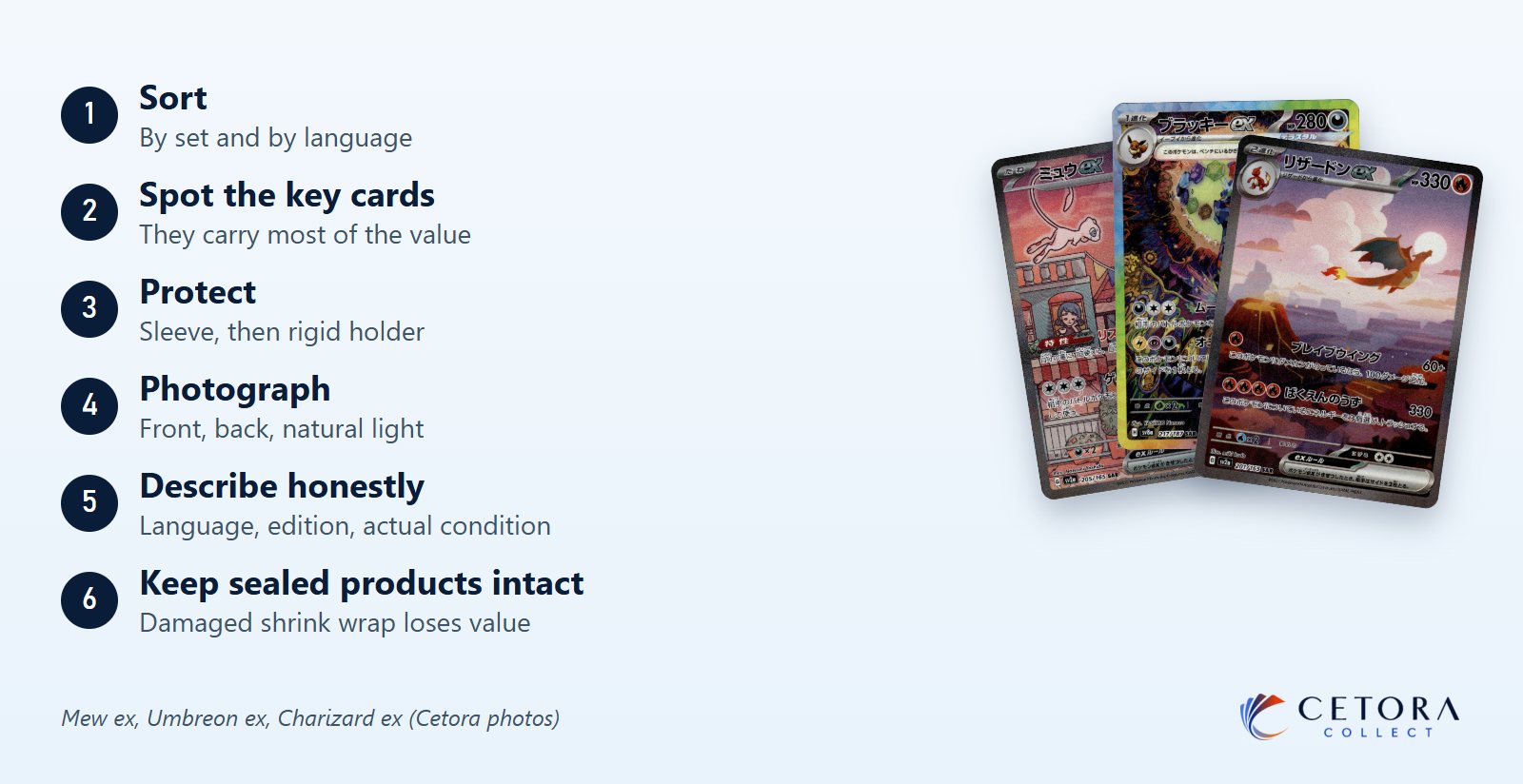
Options for selling your cards in Switzerland
Cardmarket: the major European marketplace
Cardmarket brings together a very large number of buyers and sellers of trading cards in Europe. Its main strength is visibility: your card is seen by collectors all over the continent. The platform charges a commission of 5% of the sale price (excluding shipping costs), capped at 100 euros. Sellers based in Switzerland are accepted. For your buyers in Switzerland, Cardmarket has been charging Swiss VAT itself since October 2025. However, Switzerland is not part of the European Union: an item sent to a European buyer goes through customs, which can cost them fees and put some buyers off.
Ricardo: the go-to option in Switzerland
Ricardo is the best-known classified ads and auction platform in Switzerland. Your buyers are in Switzerland, which makes shipping simpler and avoids customs formalities. The trade-off is that the audience for a specific card is smaller than across Europe. Listing is free; Ricardo charges a commission of 10% of the sale price for cards (from 8 to 12% depending on the category), capped at 290 francs: the applicable rate is shown in the listing form before you publish. With the Protection+ option, the buyer pays by TWINT or by card, and Ricardo only pays you once the buyer has confirmed receipt.
eBay: a global audience
eBay lets you reach buyers all over the world, which can make all the difference for Japanese cards, graded cards or highly sought-after pieces. For a private seller on eBay.ch, fees come to around 12% of a typical sale: 11% of the total amount (shipping included) up to 1’990 francs, then 2% above that, plus 0.55 francs per order and 0.38% in regulatory fees, with a surcharge on some sales outside Switzerland and the eurozone. International shipping is also more expensive, slower and riskier.
Facebook, WhatsApp and Discord groups
Collector groups let you sell without paying commission, often in person. They are well suited to local deals and mid-value cards. But there is no protection at all: they are a favourite hunting ground for payment scams and fake buyers.
Conventions and card shows
Trading card shows are held regularly in Switzerland, such as CardshowSwiss in Bern or TCC Switzerland in Dietikon, and conventions such as Fantasy Basel have an area set aside for card games. There you can meet buyers and dealers, and sell directly. The prices offered by the dealers there are buyback prices, but the sale is immediate.
Consignment
Some shops will sell your cards for you, in return for a commission. There is nothing for you to manage, but you only get your money once the card has sold, which can take time.
Professional buyback
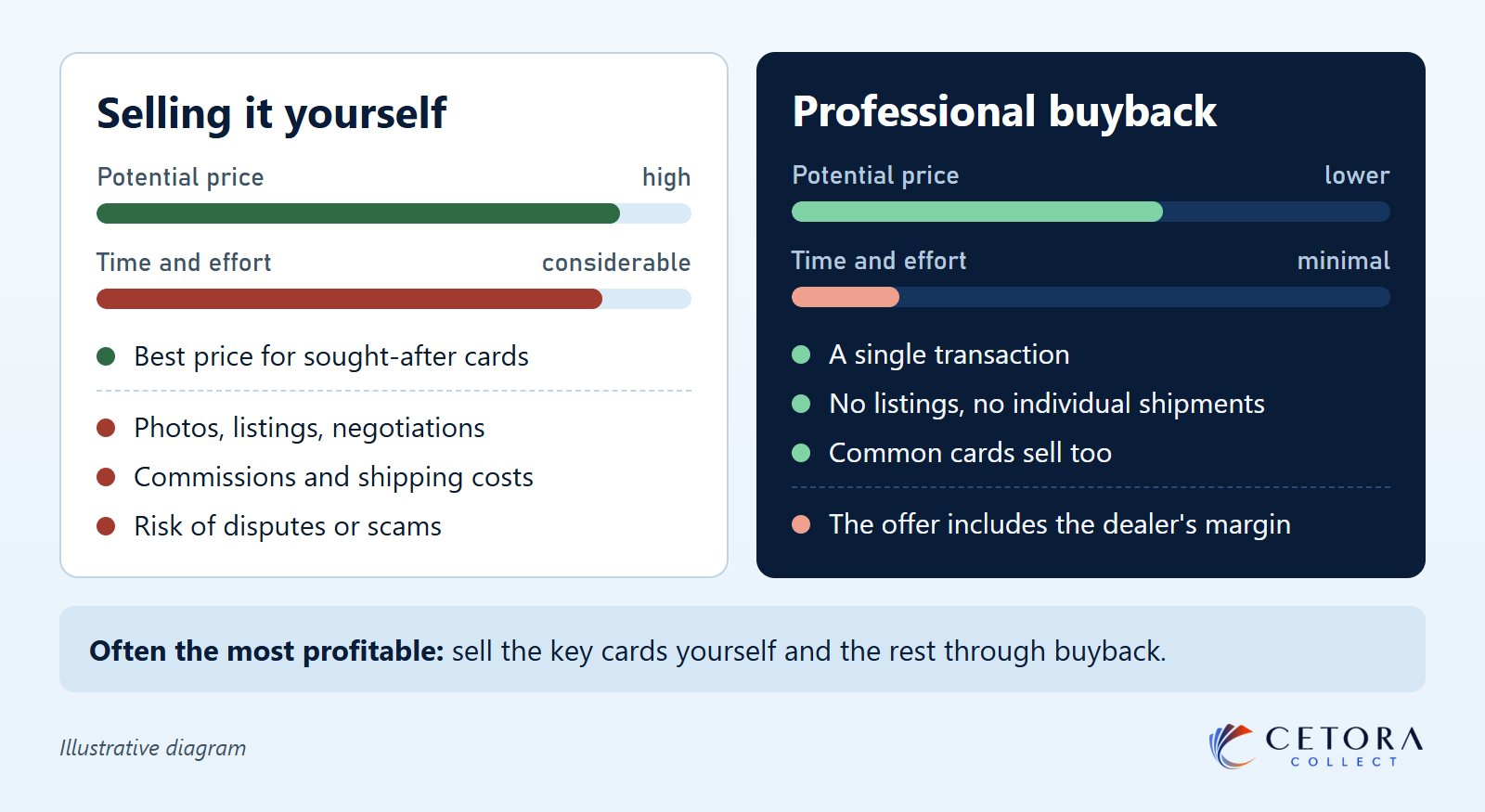
A professional makes you an offer for all or part of your collection, and you are paid in one go. It is the simplest and quickest option, especially for a large collection. The price offered is lower than the retail price: the professional has to resell the cards, taking on their own costs, time and risk.
The comparison
| Option | Price achieved | Fees | Effort | Timescale | Risks |
|---|---|---|---|---|---|
| Cardmarket | High | 5%, max. 100 € | High | Variable | Disputes, shipping |
| Ricardo | High to moderate | 10%, max. CHF 290 | High | Variable | Disputes, shipping |
| eBay | High (sought-after cards) | Approx. 12% | High | Variable | International shipping, disputes |
| Groups | Moderate | None | Moderate | Quick to variable | Scams, no protection |
| Conventions | Moderate (dealer prices) | None | Low | Immediate | Low |
| Consignment | Moderate to high | Shop commission | Low | Long | Uncertain timescale |
| Professional buyback | Below retail price | None | Very low | Quick | Low |
Selling your cards yourself: what you really need to plan for
Selling directly offers the best potential price. But it involves real work, which people often underestimate:
- sharp photos, front and back, of every valuable card;
- accurate listings: set, number, language, honestly described condition;
- questions and negotiations, sometimes over a few francs;
- careful, tracked shipments, card by card: sleeve, rigid holder, reinforced envelope. In Switzerland, Swiss Post pays a maximum of 500 francs in compensation for a registered letter, 1’500 francs for a parcel with the Signature option and 5’000 francs with the Assurance option, and only up to the amount of the proven loss;
- a risk of disputes: card “not as described”, parcel “never received”, refund requested;
- unsold cards: common cards do not sell well individually, and often end up in a cut-price lot.
How much will you really be left with?
To compare a direct sale with a buyback offer, you need to think in terms of the net amount: what you receive once all costs have been deducted. For a card sold online, deduct:
- the platform's commission;
- any payment fees;
- the cost of shipping and packaging, when it is not fully covered by the buyer;
- the insurance for valuable shipments;
- and, to be honest with yourself, the time spent.
What each platform takes, depending on the sale price:
| Sale price | Cardmarket (5%, max. 100 €) | Ricardo (10%, max. CHF 290) | eBay.ch (11% then 2% from CHF 1’990, plus fees) |
|---|---|---|---|
| CHF 50.– | CHF 2.50 | CHF 5.– | CHF 6.25 |
| CHF 200.– | CHF 10.– | CHF 20.– | CHF 23.30 |
| CHF 1’000.– | CHF 50.– | CHF 100.– | CHF 114.35 |
| CHF 5’000.– | 100 € (cap) | CHF 290.– (cap) | CHF 298.65 |
Cardmarket works in euros: the cap of 100 euros applies to the converted amount. Shipping, packaging and insurance come on top of these commissions. A card sold for CHF 200.– on Ricardo therefore earns you CHF 180.– before shipping costs, and around CHF 177.– on eBay. For a piece worth several thousand francs, the Cardmarket and Ricardo caps, and eBay's reduced rate above 1’990 francs, change the comparison completely. Platform fees change over time: check them when you come to sell.
For a card worth several hundred francs, selling directly often remains the most profitable option. For a hundred cards worth a few francs each, the calculation is quickly reversed: time and shipping costs eat up most of the profit.
How a professional buyback works
At Cetora, the process is deliberately simple:
- You describe your collection in our form: what you are offering (single cards, graded cards, sealed products or a whole collection), the approximate number of items, and a few photos. There is no need to state a price.
- We review your request and get back to you by email, with questions if needed.
- You receive an offer, and you remain free to accept it or not.
If the offer suits you, we arrange the shipping of the cards and the payment together, by email.
We mainly buy Pokémon cards, but you can also get an offer for other collectible cards: One Piece, Dragon Ball, Lorcana or sports cards.
Comparing a buyback offer
To assess an offer, compare it with the market value of your cards (recent sales, not asking prices), then with the net amount you would get by selling them yourself. There is always a gap: it is the price of the time, costs and risk you will not have to take on. Feel free to ask which cards account for most of the offer.
Our advice: the mixed approach
For a complete collection, the best solution is often a mix: sell the few cards that are truly worth selling individually yourself, and part with the rest all at once. You get a good price for your key pieces, without spending weeks offloading hundreds of common cards.
Avoiding scams
- Be wary of buyers in a hurry who offer to pay more than the asking price, or to take the deal off the platform.
- For a payment by bank transfer or TWINT, check that the money has actually arrived in your account before shipping: a screenshot proves nothing.
- A TWINT payment you receive arrives in your account automatically, with nothing to approve. A “payment request” you have to accept in order to get paid, or a request for a TWINT code, is a scam flagged by the Federal Office for Cybersecurity.
- Be wary of links to fake courier or payment websites sent by a “buyer”: they are used to steal your payment card details.
- For in-person sales, choose a public place and check the payment on the spot.
- Photograph the card and the packaging before shipping, and keep the tracking number.
- For a graded card, note down the certificate number: it lets you prove the identity of the card you sent.
Frequently asked questions
Where can I sell my Pokémon cards in Switzerland?
On a platform such as Ricardo, Cardmarket or eBay to aim for the best price, in collector groups or at a convention to sell locally, or to a professional to sell an entire collection quickly.
How do I sell an entire Pokémon collection?
Sort it, spot the valuable cards, then choose between individual sales, lots and buyback. For a large collection, professional buyback or a mixed approach saves months of work.
Should I get my cards graded before selling them?
Only for sought-after cards in flawless condition, whose graded version sells for significantly more. For other cards, the cost and turnaround time of grading do not pay off. See our guide Getting a Pokémon card graded.
Do professional dealers buy all cards?
They are mainly interested in sought-after cards, graded cards, sealed products and large collections. Common cards are usually bought in bulk, at a modest price.